Slotted Window Folding Carton Boxes for Kitchen Utensils
A die-cut E-flute corrugated folding carton with a slotted display window for kitchen utensils, chopping boards and cookware sets.
- Low MOQ
- 7d+ From production
- Full OEM / ODM
- FSC Options
Request a Custom Quote
Material
Greyboard, SBS board, kraft and specialty paper
Printing
Offset with Pantone matching, foil and spot UV
Turnaround
From about 7 business days after proof
Key Specs
| Material | E-flute corrugated kraft or white liner, die-cut slotted window with fold-back flap, optional acetate window insert, straight tuck end |
|---|---|
| Board and GSM | 180g - 250g E-flute corrugated liner, kraft outer, white inner on request, BC double-wall for heavy multi-piece sets |
| Printing | Offset CMYK on outer face, matte or aqueous gloss varnish, spot UV on window frame, silver or gold foil band, die-cut window registration |
| Box Style | Die-cut folding carton with slotted display window, straight tuck end, optional acetate insert, auto-lock bottom on request, 2000 pcs MOQ |
| FSC Option | FSC certified corrugated kraft and white liner available, recycled board on request |
Product Description
Where slotted window folding carton boxes for kitchen utensils are used
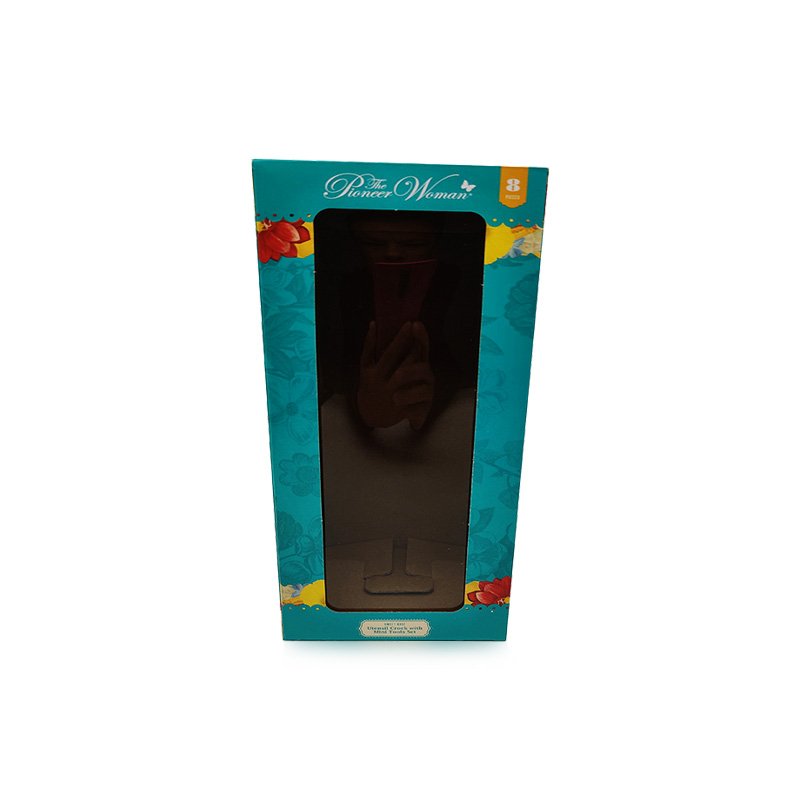
A slotted window folding carton is a corrugated box with a die-cut opening on the front face so the utensil or tool inside can be seen without opening the pack. It is the retail pack for kitchen knife and block sets, spatula and utensil tool kits, chopping boards, measuring cup sets, peelers and graters, and for full cookware starter bundles that sit side by side on a kitchenware shelf next to each other. The window sits at the exact height of the product inside so a shopper sees the knife handles, the wooden board edge or the stainless steel cup rims through the slot, which means the pack sells the item as well as carrying it.
They also carry subscription drop sets, holiday kitchen gifts, and DTC single-item orders where the customer wants to see what arrives before the parcel is opened. Compared with a plain corrugated carton that opens to reveal the product after opening, the slotted window acts as a shelf-ready display that works without a hanger or a backing card, and compared with a blister pack that has no structural strength, the carton survives a courier run and stacks on a pallet without crushing.
Window die-cut, corrugated flute and carton print
The shell is scored and die-cut from E-flute corrugated liner at 180g to 250g - a kraft liner for natural wood-handled utensils and stainless steel tools, a white liner for colour-printed promotional sets - with a straight tuck end for single sets and an auto-lock bottom for heavier chopping board or multi-piece bundles. The slotted window is cut on the same die as the carton: a U-shaped opening edged with a fold-back flap that tucks behind the liner to stay in place without glue, and an optional acetate or polypropylene insert glued into the slot so the window opens as a full transparent panel rather than a partial cut. Window height and position are sized to the actual product - a knife block needs a tall slot across the front, a measuring cup set needs a wide slot across the top - so nothing shows behind the tool and the product sits level.
Print is offset CMYK on the outer face with matte or aqueous gloss varnish so the kraft surface stays smudge-free through shelf handling, and the window frame carries a spot UV or a silver or gold foil band to frame the cut without covering the view. On a kraft liner the window slot is cut first so the liner colour stays uniform around the edges, while on a white liner the window slot carries a printed border that ties into the artwork. The same straight-tuck carton structure with a die-cut window is the base for our Custom Printed Tuck Boxes and our Folding Carton Boxes range, so a kitchenware brand can share a window dieline family and change only the product-specific print.
Why custom slotted window folding carton boxes from CRIIO
CRIIO sizes the window to the actual utensil set first and works back to flute grade, slot position and liner colour before platemaking. The window height is proved on a physical sample loaded with the representative tool so nothing shows behind the product, the flute is tested with the actual weight of the bundle so the box does not bulge when stacked, and the print proof is pulled on the specified liner - kraft or white - so the CMYK on kraft and the CMYK on white are both approved on the actual stock. Minimum order is 2000 pcs per size, and a physical sample is signed off so slot position, flap tuck and print alignment match the approved piece before the run.
Cartons ship flat and bundled so storage and freight are charged on board rather than on air. A size change is a new dieline on the same press rather than a new machine setup, and a re-run pulls against the approved sample so slot position and print colour stay matched through season after season. For ranges that carry the same artwork across formats, the window structure transfers to our product boxes and the kraft liner transfers to our kraft mailer boxes, while the corrugated flute and print coverage sit on the corrugated boxes range. The retail and e-commerce volumes we quote on are planned from the same artwork deck so a kitchenware brand does not have to re-separate files for each production run.