
A 30 ml serum and a one-carat diamond ring both need a box that opens well. That is roughly where the similarity ends. Jewelry packaging is not beauty packaging with more foil. The value density inside is higher, the opening gesture is more deliberate, and the customer keeps the box — a lipstick tube spends three weeks in a drawer, a ring box sits on a dresser for years.
This guide breaks down the structures, inserts and finishes that move perceived value for jewelry and watch brands ordering 500 to 20,000 units. Every recommendation is tied to a real trade-off: margin vs presentation, lead time vs unboxing, recyclability vs premium hand feel. Start with the insert and work outwards.
Why jewelry packaging is different from beauty
The table below is the short version of a conversation we have with every jewelry brand before we draft the first dieline.
| Decision point | Beauty packaging | Jewelry packaging |
|---|---|---|
| Primary job | Signal price point on shelf | Signal value during the opening moment |
| Board | 300–400 gsm coated paperboard | 1.5–2.5 mm greyboard with plush wrap |
| Insert tolerance | 5% flex acceptable | Under 1 mm cavity tolerance |
| Afterlife | Discarded after use | Kept for years, often reused |
| Freight cube | Collapsed flat inbound | Assembled, corner-protected |
| MOQ | From 500 pcs | From 500 pcs, tooling amortizes at 3,000 |
| Opening gesture | Functional, overlooked | Memorable, photographed, shared |
Two lines stand out. Insert tolerance under 1 mm means the cavity is routed or pressed to match the exact setting height and prong style of the piece. A ring sitting 2 mm proud reads as a mistake. Kept for years means the board has to hold shape and the wrap has to resist scuffing longer than the product cycle.
Lid-and-base structures: the default for rings and necklaces
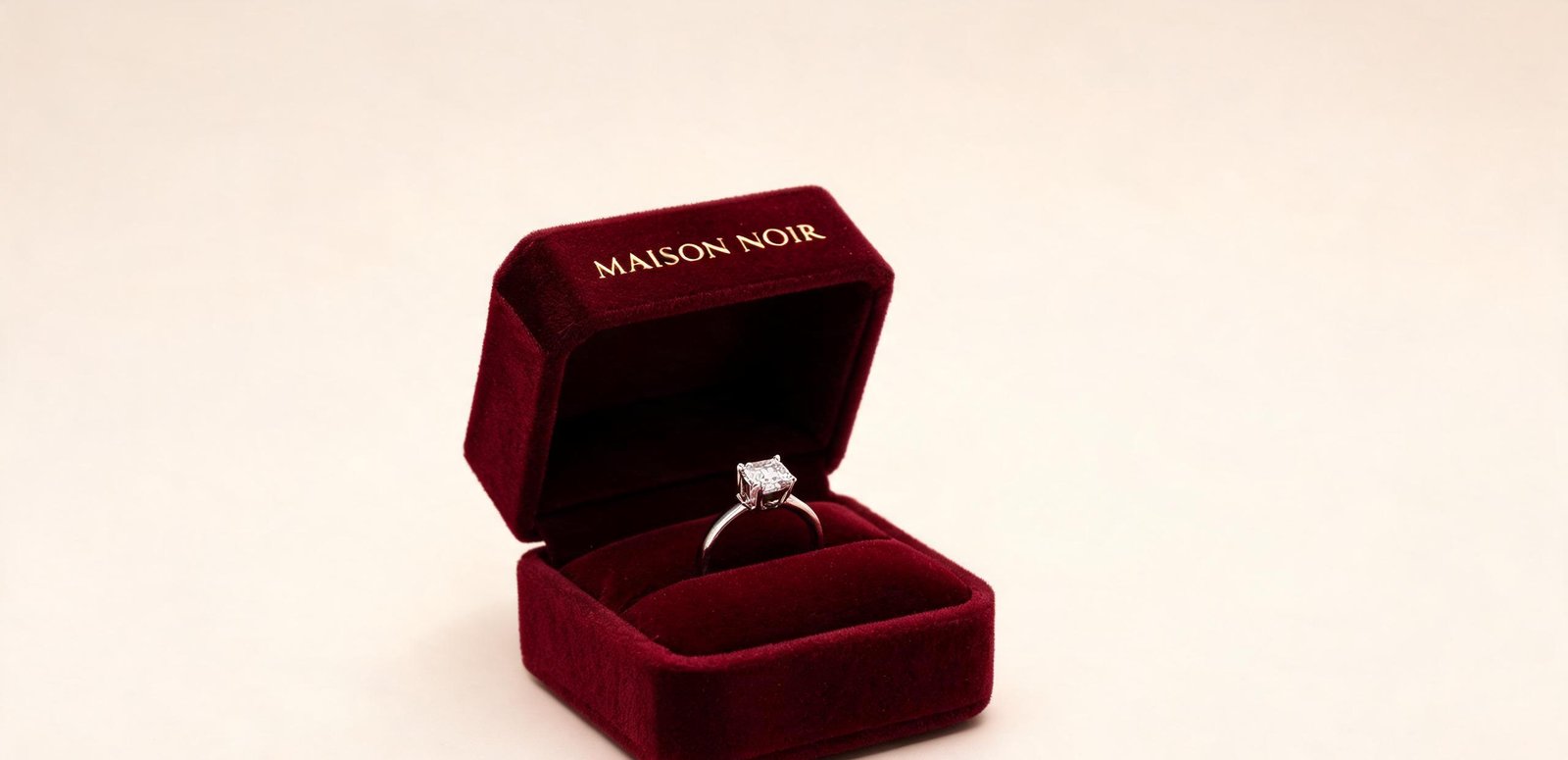
A lid-and-base jewelry box is two pieces of 1.5 to 2.5 mm greyboard, each wrapped in specialty paper, assembled so the lid closes over the base with a minimal reveal. It has no moving parts and the opening gesture is instantly readable — lift the lid, the piece is revealed.
The wrap is where most brands leave value on the table. Matte board feels flat, glossy laminate fingerprints, velvet absorbs ink and can look dull, linen shows foil registration clearly, soft-touch scratches on board lighter than 2 mm. The right wrap survives both printing and the hands that will open it.
The reveal gap — visible space between lid and base when closed — matters more than most brands think. A 1.5 to 2.5 mm gap reads clean. Anything larger lets the insert shift during shipping. We specify this range on every dieline and measure it on sample approval. Ten seconds of checking prevents fifty units of rework.
Double-door watch boxes: presentation that frames the piece
A rigid double-door watch box opens from both sides to reveal the watch in the center on a rotating cushion or fixed velvet pad. It is a presentation structure first and a protection structure second. Watches carry moving parts — the crown, the clasp, the bracelet links — and a double-door design gives each component its own visual space.
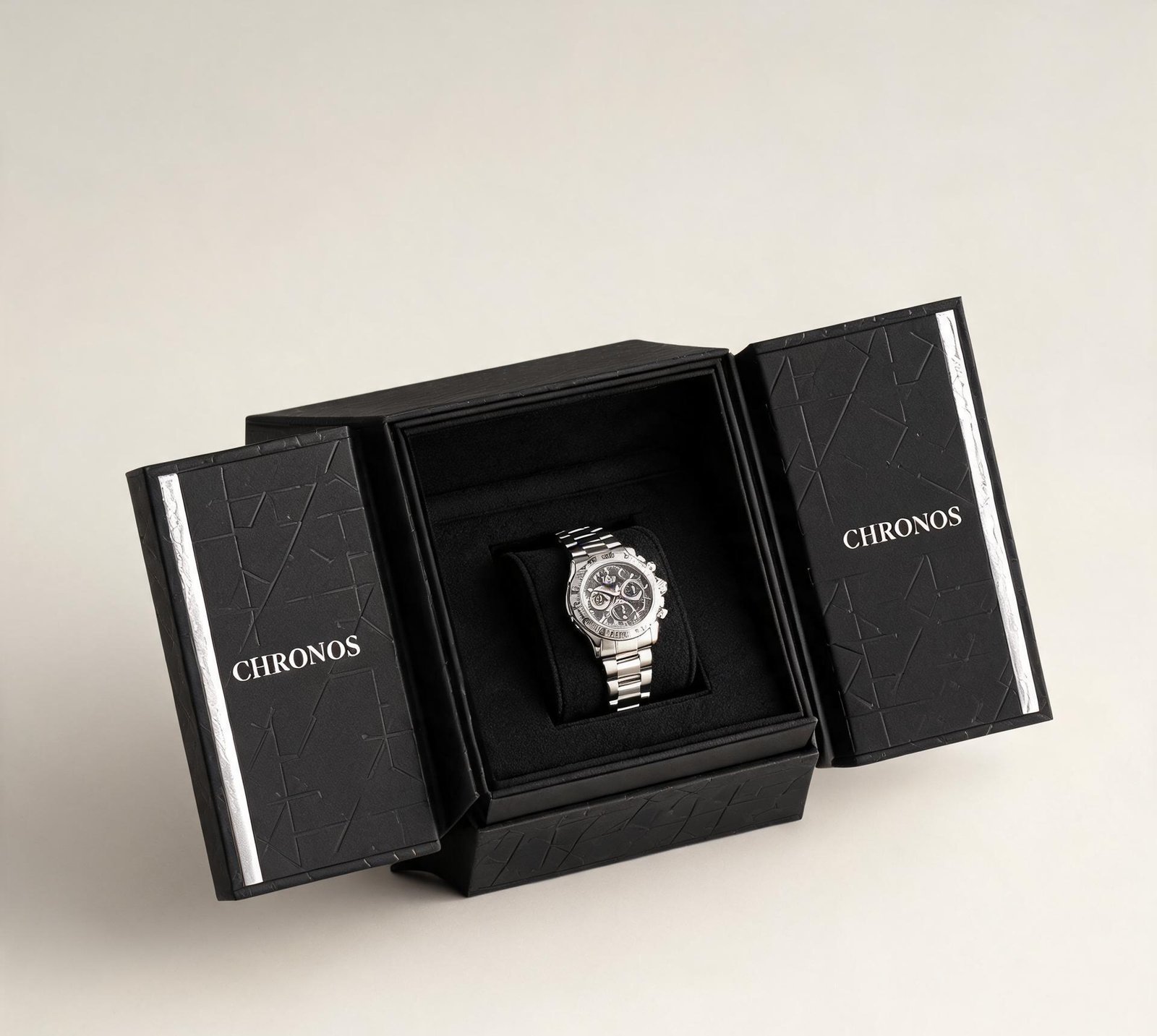
Protection comes from the cushion cradling the case back, a soft flap covering the crystal, and corner board preventing flex during a drop test. Cushion density is a specification — too soft and the watch sinks; too firm and the case edges leave indentations. We test at 30, 40 and 50 durometer on sample approval.
The trade-off: a double-door box reads more premium but occupies 2–3 times the freight cube inbound and 4 times retail shelf space. For a launch where the unboxing video is the primary asset, justified. For daily e-commerce shipping, not.
Inserts that actually protect: three materials compared
The insert is where perceived value lives. A diamond ring in a correctly routed velvet cavity reads as a thousand-dollar piece regardless of the box around it. The same ring in a generic foam block reads as a department-store impulse purchase.
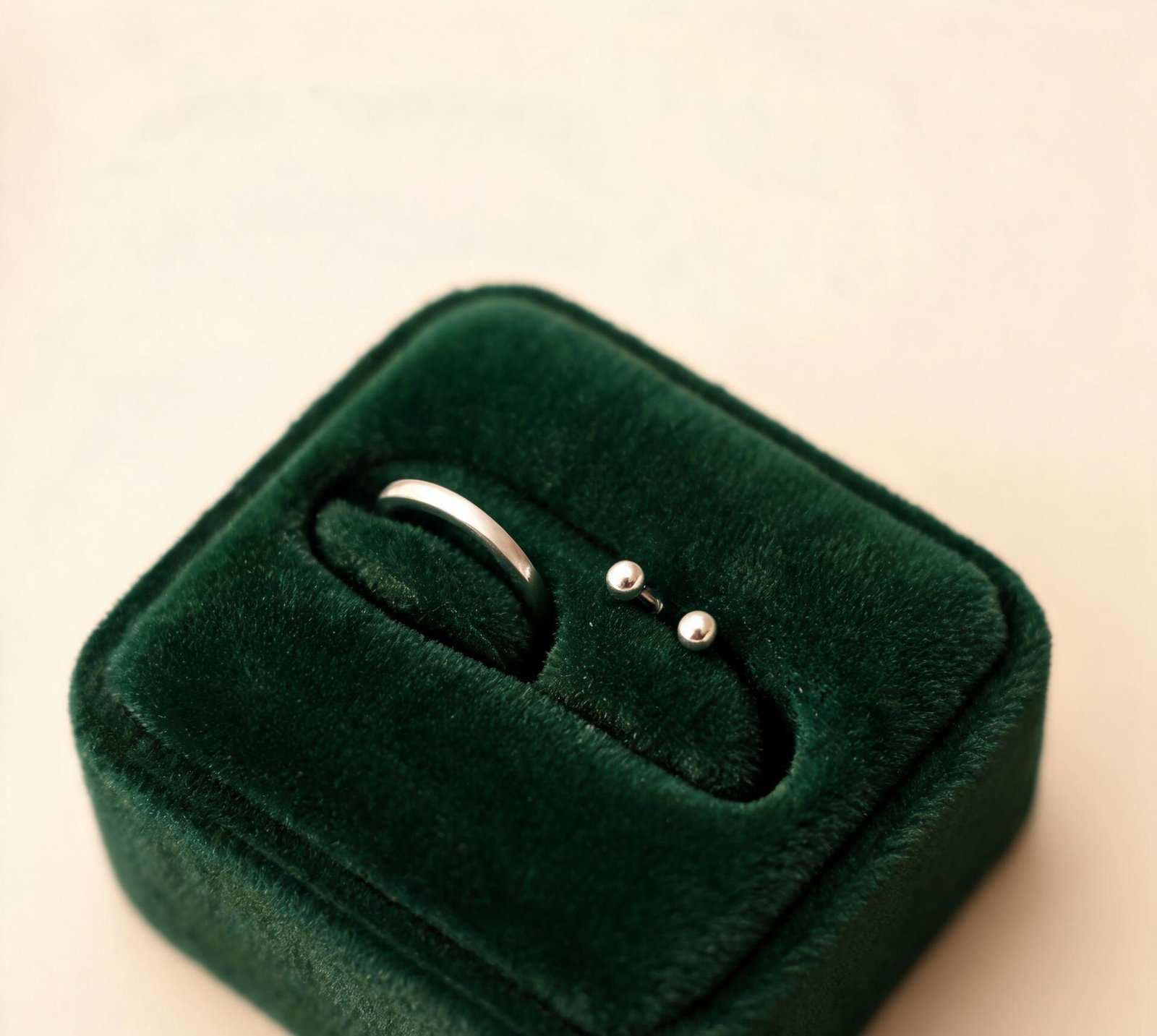
- Routed velvet. Solid foam or compressed fibre with velvet glued top and bottom, precision-routed to exact profile. Tolerance under 1 mm. Premium option, highest tooling cost, amortizes at 3,000 units.
- Flocked EVA foam. Closed-cell EVA with velvet flocking, die-cut or hot-pressed. Tolerance 1–2 mm. Cheaper, recyclable with water-based flocking, but flocking can wear after a hundred opens.
- Moulded pulp. Paper-based fully recyclable cavities. Tolerance 2–4 mm. Lowest cost. Good for bracelets or shipping inserts, not recommended for rings or watches.
Two insert rules we enforce on every jewelry project. One: every cavity must be lined all the way to the bottom. If the customer sees grey foam when lifting the ring, the premium disappears. Two: earring post holes need a soft insert or the post scratches the pendant back.
Finishes that signal luxury without shouting
Finishes on jewelry boxes work differently than on beauty cartons because the box is held, not just looked at. The best finishes reward being touched. The worst stop looking good after three weeks on a dresser.
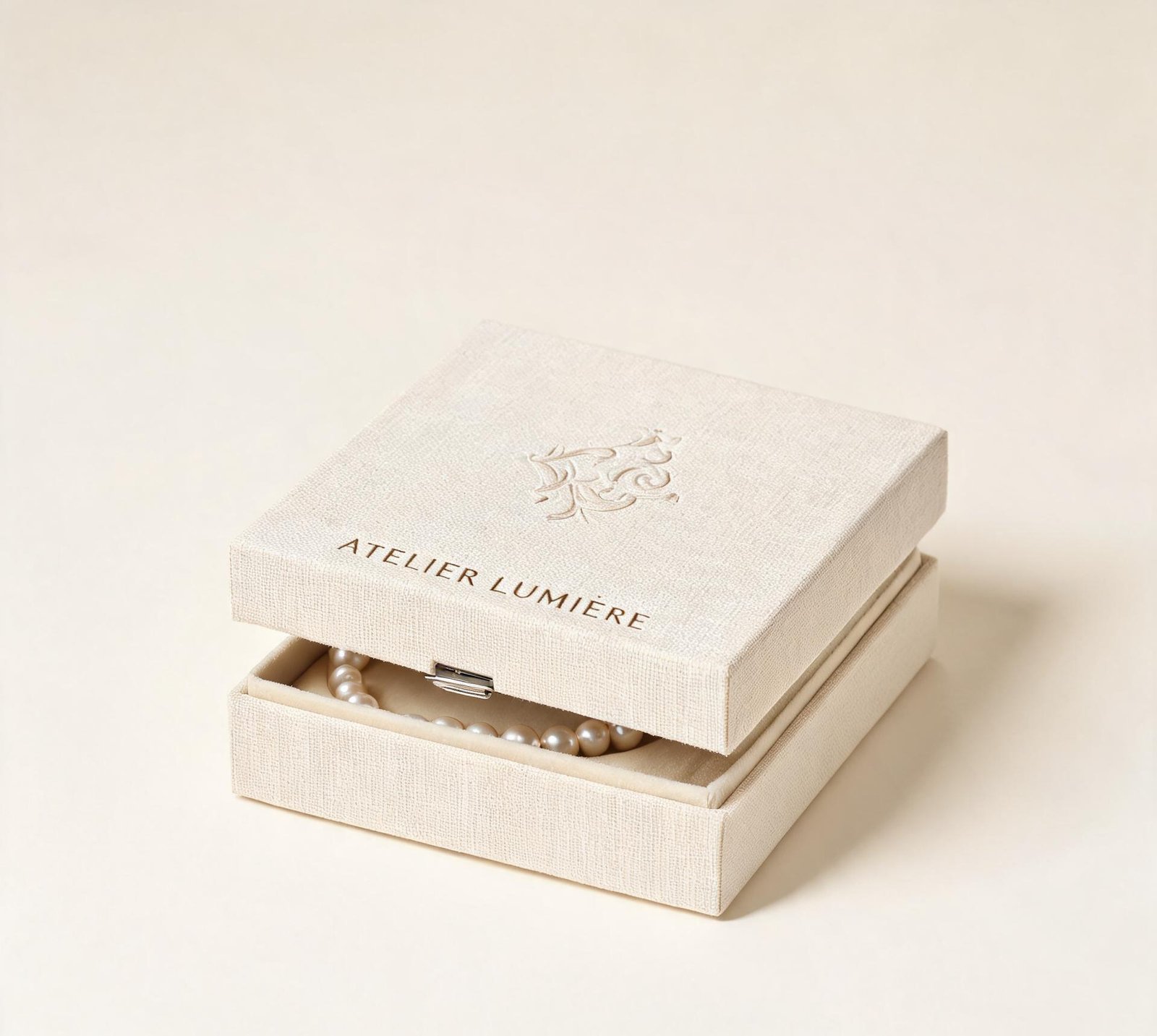
Soft-touch laminate gives a velvet-like hand feel and is the single most cost-effective premium upgrade. It resists fingerprints better than gloss and survives scuffing on 2 mm board or thicker. Spot UV over soft-touch creates a gloss contrast that photographs extremely well in social content — exactly why we recommend it for DTC brands.
Hot foil stamping should be used sparingly. One foil treatment on the brand name or a border works. Three treatments read as noisy, not premium. Foil registration on greyboard wrap is more forgiving than on coated board, so place foil on the wrap, not the base board.
Blind embossing — pressing a pattern without ink or foil — costs almost nothing and reads premium when done right. The key is embossing on wrap paper, not board, and keeping the pattern to a single flourish. Blind emboss on linen texture paper is particularly effective.
One finish to avoid: glossy laminate over greyboard rigid boxes. The laminate wrinkles at corners after assembly because board and laminate expand differently. Soft-touch or matte only.
Drawer boxes and alternative structures
Not every piece needs a lid-and-base or double-door box. Drawer boxes and magnetic-closure flips work for specific use cases, each solving a problem the defaults do not.
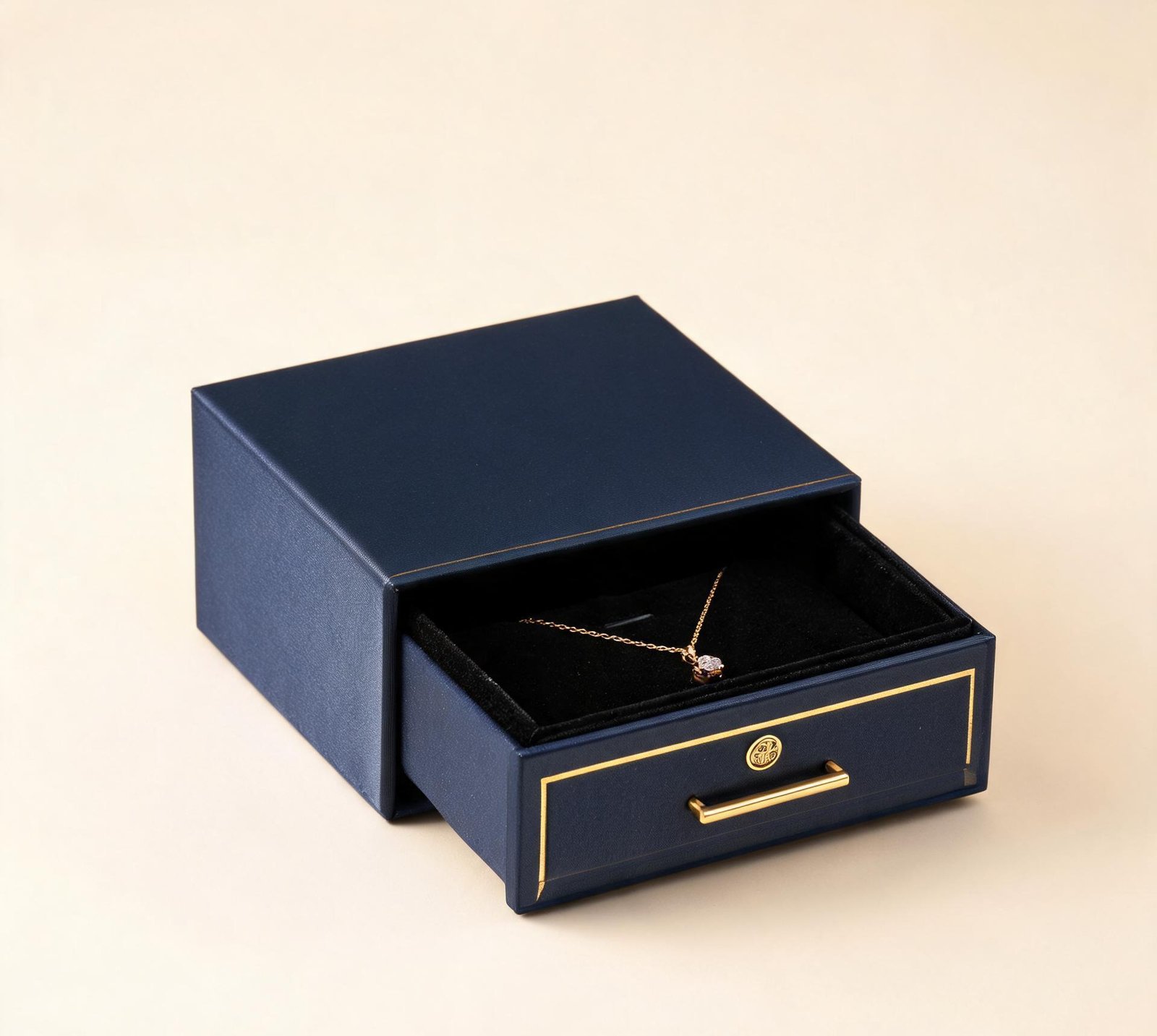
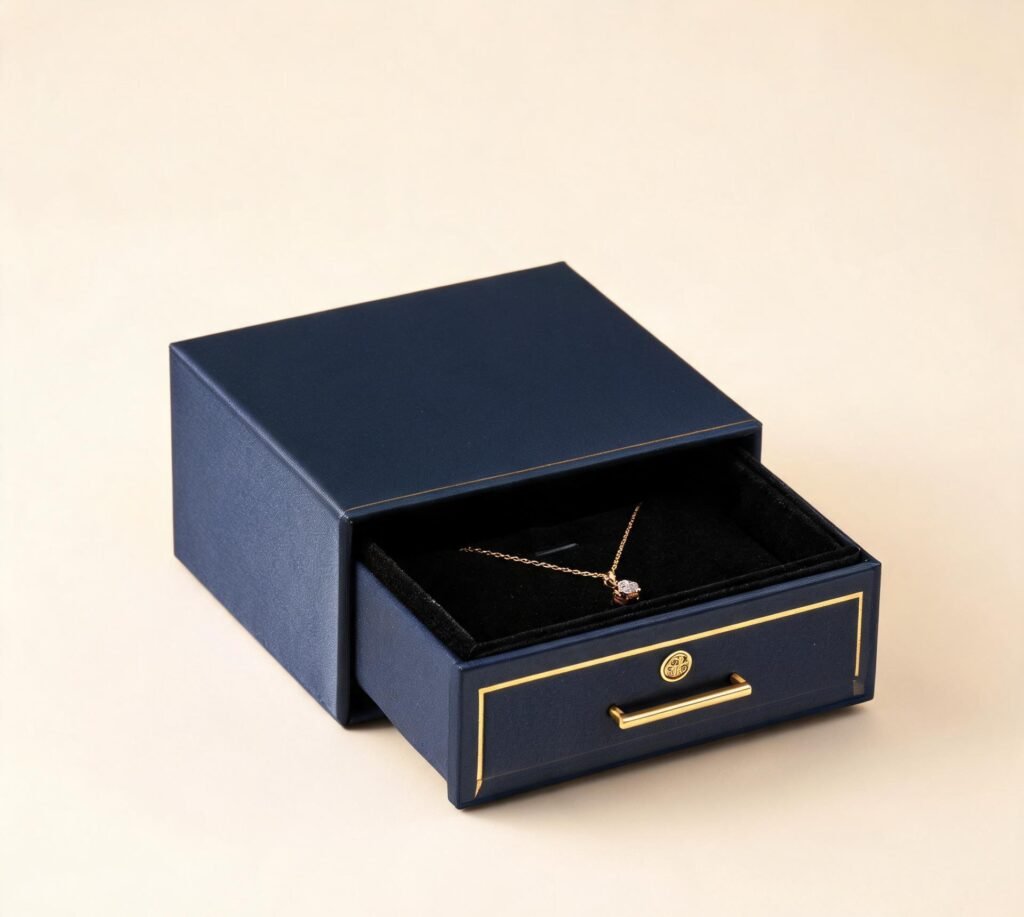
A drawer box is a rigid sleeve with a tray that pulls out on a track. The opening is slower and more deliberate, ideal for pendants, bracelets and multi-piece sets. The tray is almost always velvet-lined, and the pull mechanism can be a ribbon, handle bar or finger cut-out. Drawer boxes cost roughly 15 to 20 percent more than a comparable lid-and-base because sleeve and tray require tighter assembly tolerances.
A magnetic-closure flip box combines the quick-open feel of a lid-and-base with a satisfying snap when closing. The magnet is a rare-earth disc buried flush under the wrap. Magnetic closures work best on boxes opened and closed repeatedly — daily-wear jewelry, travel sets — because the magnet holds alignment better than a friction fit.
Sizing checklist before you order
Three numbers decide most jewelry packaging projects, and most brands get all three wrong on the first draft. Work through these before asking for a quote.
- Exact dimensions of every piece. Not approximate. Gem setting height, bracelet width at the widest point, ring band width, clasp length. Every number goes into the insert dieline. Get them from the CAD file or manufacturer, not from the product page.
- Insert tolerance. Decide before ordering inserts. 0.5 mm is premium and requires routed velvet. 1.5 mm is good and allows flocked foam. 3 mm is only acceptable for non-critical pieces. Tolerance drives insert cost more than any other factor.
- Box outer dimensions and shelf facing. Check both the shelf the box will sit on and the shipper it will travel in. A ring box 10 mm too tall for a standard mailer means dimensional weight on every shipment. A watch box 5 mm too wide for a retail planogram means losing the listing.
One more check: confirm insert thickness before finalizing board thickness. A 12 mm insert plus 2 mm top board plus 2 mm base plus 2 mm wrap allowance equals 18 mm minimum box height. Brands often forget the insert and end up with a lid that will not close.
How a jewelry packaging project runs
Our process is shorter than most brands expect because we front-load the two places where risk lives: the insert dieline and sample approval. Minimum order is 500 pieces per design. We run jewelry boxes, lid-and-base structures, watch boxes, inserts and printing all under one roof, so you can compare options on a single quote.
- Brief and dieline. Send exact product dimensions, CAD files, piece photos, quantity band and channel. We draft the flat pattern at no cost with the insert profile overlaid. Two to three working days.
- Sample. Pre-production sample on the specified board, wrap and insert, three to five days from dieline approval. We test the insert fitment with your actual product or a weight/size equivalent.
- Bulk and inspection. Production runs seven to fifteen days after sample approval. Inspection before boxes close: insert routing, board caliper, wrap alignment, foil registration, corner glue and a 50-unit drop test.
Start your jewelry packaging project with Criio today — free dieline within three days, sample within five, bulk production under fifteen days from approval.