
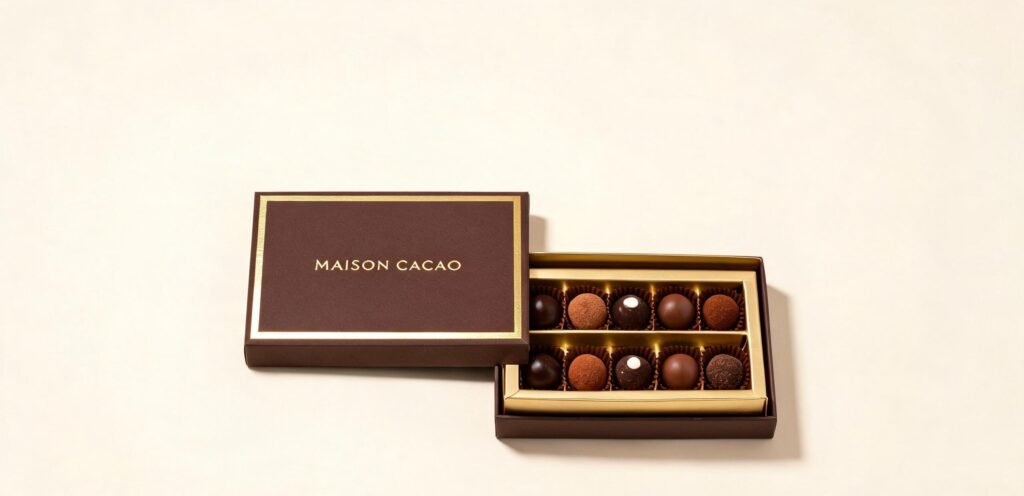
Chocolate is the one product in this series that the packaging can actually ruin. A chocolate box lined with the wrong board turns a glossy truffle grey within a week, because cocoa butter migrates into paper fibre and the fibre gives it back as a fat stain. Food-safe construction is not a compliance afterthought here. It is the first decision.
This guide covers the board grades, liners, trays, carton structures and sizing rules we use for chocolate brands ordering 500 to 20,000 units.
Why chocolate packaging is a food-safety problem first
Chocolate is 30 to 40 percent fat by weight, and that fat does not stay where you put it. At 25°C cocoa butter migrates into any absorbent surface it touches. Uncoated paperboard absorbs it, and the absorbed fat oxidises into the pale grey bloom that makes a premium truffle look stale. The failure is invisible on day one and obvious on day ten.
Direct contact brings a second constraint most brands discover late: printing. UV inks can migrate through paper into high-fat food, which is why contact packaging uses low-migration inks, water-based coatings and virgin fibre board. Recycled board is right for the outer rigid box and wrong for the layer touching the product.
| Material option | Grease resistance | Direct contact safe | Best for |
|---|---|---|---|
| Coated SBS board, 350 gsm | None | Yes, virgin fibre | Cartons used with an inner liner |
| PE-coated board | Good | Yes | Bars and tablets in direct contact |
| PLA-coated board | Good | Yes | Compostable claims with cold chain limits |
| Water-based barrier coating | Very good | Yes | High-fat pralines and ganache |
| Greaseproof glassine liner | Excellent | Yes | Inside any box, cheapest barrier |
| Recycled board (GC2) | None | No, outer only | Rigid box wrap and shipper |
| Moulded pulp tray | Moderate | Yes | Cavities for pralines and truffles |
| PETG clear tray | Excellent | Yes | Visibility, weak recyclability story |
Two rows decide most projects. Greaseproof glassine is the cheapest real barrier: a 40 to 60 gsm sheet under the chocolates stops fat reaching the board. Water-based barrier coating costs more but removes the liner entirely, cutting one assembly step and one material from the bill of materials.
Board grades that resist grease without blocking recycling
For folding cartons we specify 300 to 400 gsm solid bleached sulphate as the default: virgin fibre, bright, and it prints well, but not grease resistant on its own. Where the carton touches the product, the choice is a coated grade — PE for availability, PLA for a compostable claim, or a water-based barrier coat for the best fat resistance per gram.
The trade-off is recyclability. PE-coated board is accepted in most paper streams at low coating weights but not repulpable everywhere. PLA composts under EN 13432 but fails at home and needs a cold chain under 40°C. Water-based coatings repulp in standard mills, which is why we default to them for brands with a public packaging commitment.
For rigid boxes, greyboard is the core and never the contact layer. A 1.5 to 2.5 mm shell wrapped in printed art paper gives the presence; a separate coated tray inside does the food-safe work.
Liners and inserts: where the fat actually goes
The insert is not decorative in confectionery. It is barrier, divider and cushion at once. Four options cover almost every project.
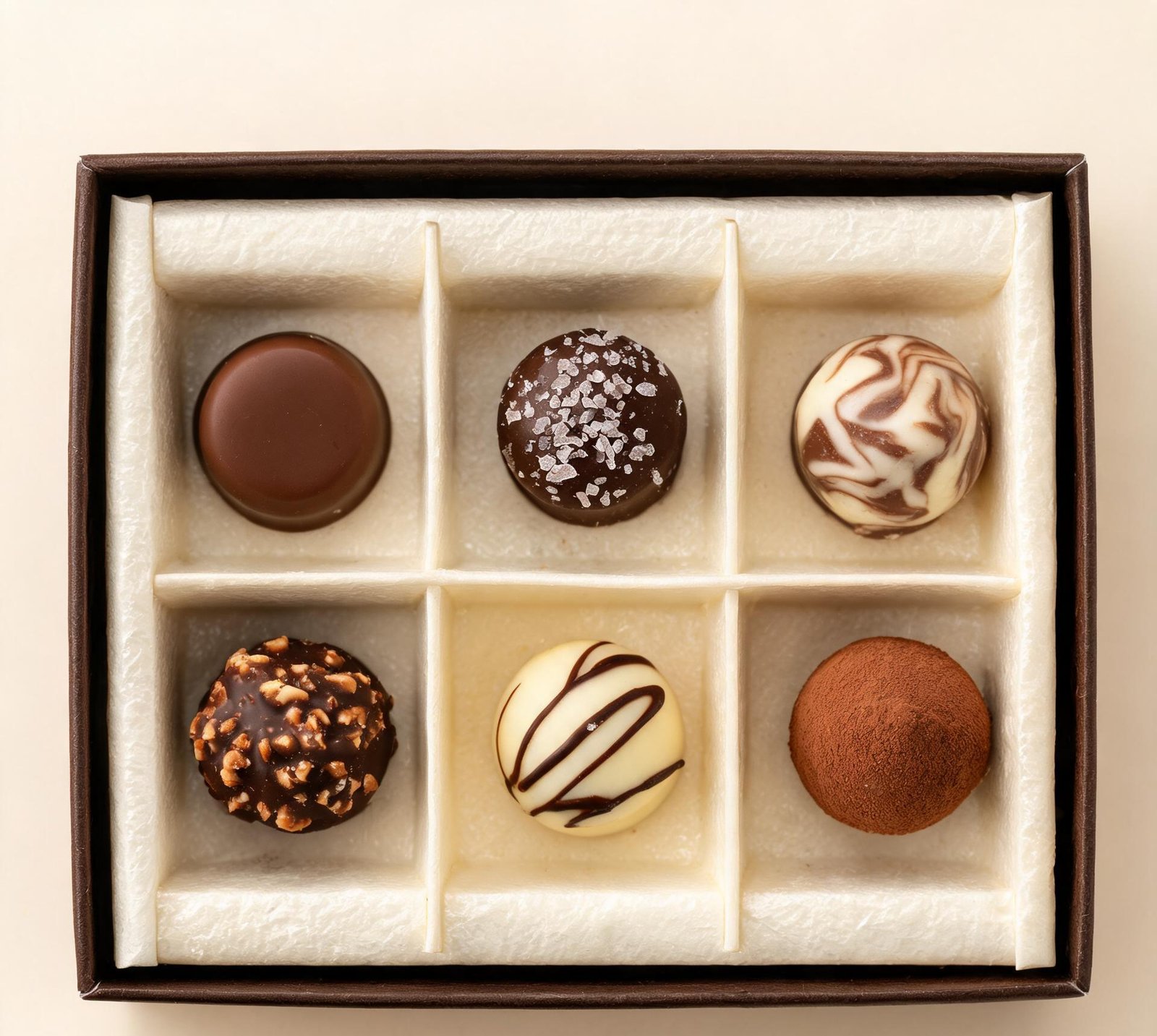
- Coated paper tray. Die-cut and folded from PE or barrier-coated board. Cheapest food-safe option at volume and recyclable in most streams.
- Moulded pulp tray. Formed fibre cavities, no coating. Fully repulpable, lowest material cost per cavity, but the fibre can mark glossy bonbons.
- Glassine-lined corrugated divider. E-flute dividers for bar-style products with a glassine sheet over the base. Good compression resistance, but the liner is placed by hand.
- PETG clear tray. The only option that shows product through the box, and the one that breaks a mono-material claim.
One rule we enforce: the liner must extend at least 10 mm past the outermost cavity on every side. Fat migrates sideways as well as down, and a liner cut flush leaves a stained ring around the box edge within a season.
Folding cartons for bars and tablets
A bar carton is printed flat, glued, collapsed and erected by hand or case packer. For a 100 g bar we specify 350 gsm SBS with a tuck-end closure and an inner glassine wrap, so the carton never touches the chocolate. That separation keeps cost down: the barrier is a few cents of glassine, not a coated board upgrade across the whole run.
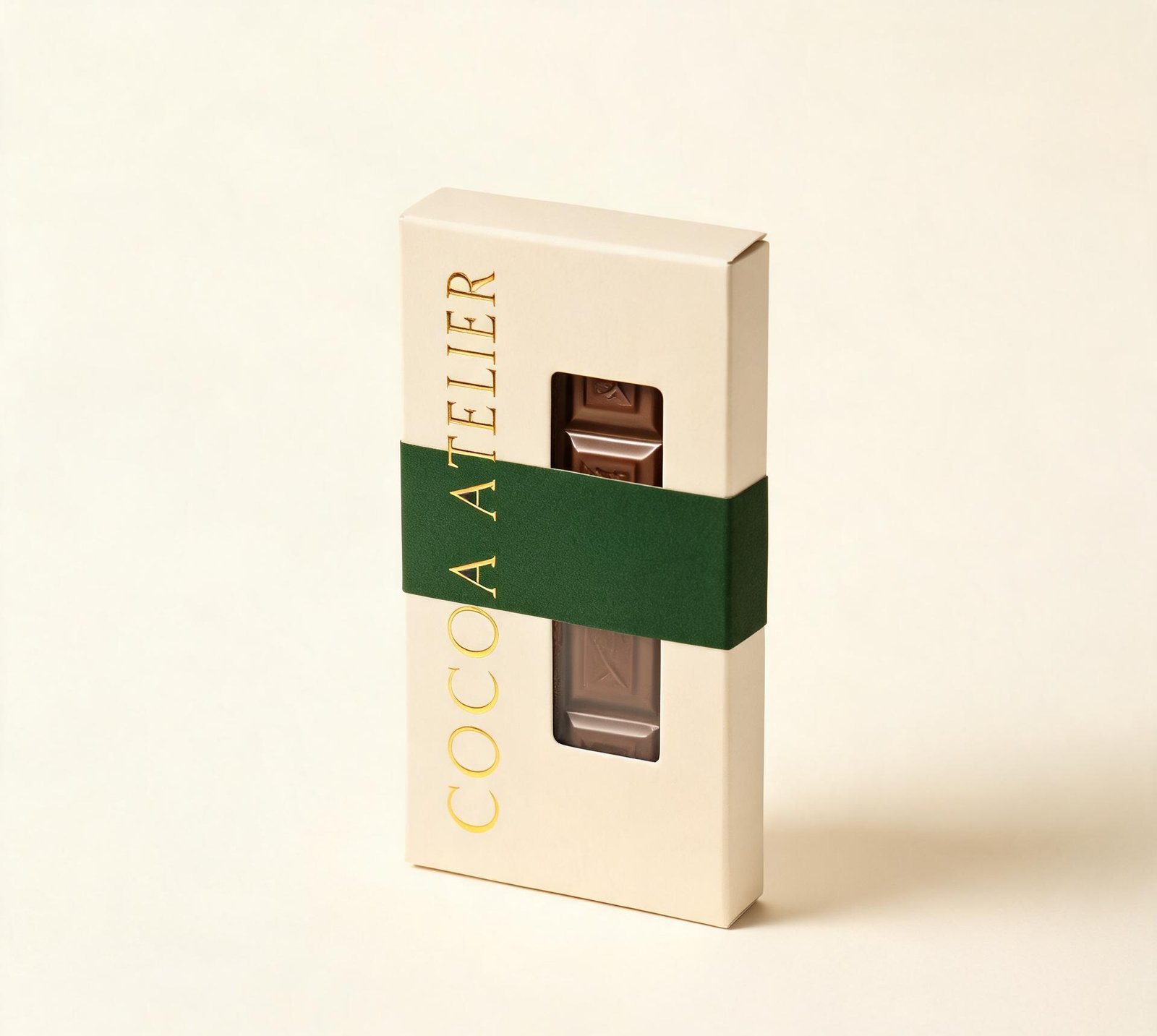
Where the carton does touch the product — loose squares, bark, broken pieces — specify a PE or barrier-coated grade and drop the glassine. You pay 15 to 25 percent more per thousand and save an assembly step, usually the better trade above 5,000 units. Keep crease lines 1 mm inside the finished dimension, or the bar will not slide out cleanly after a cold chain cycle.
Drawer boxes and gift sets
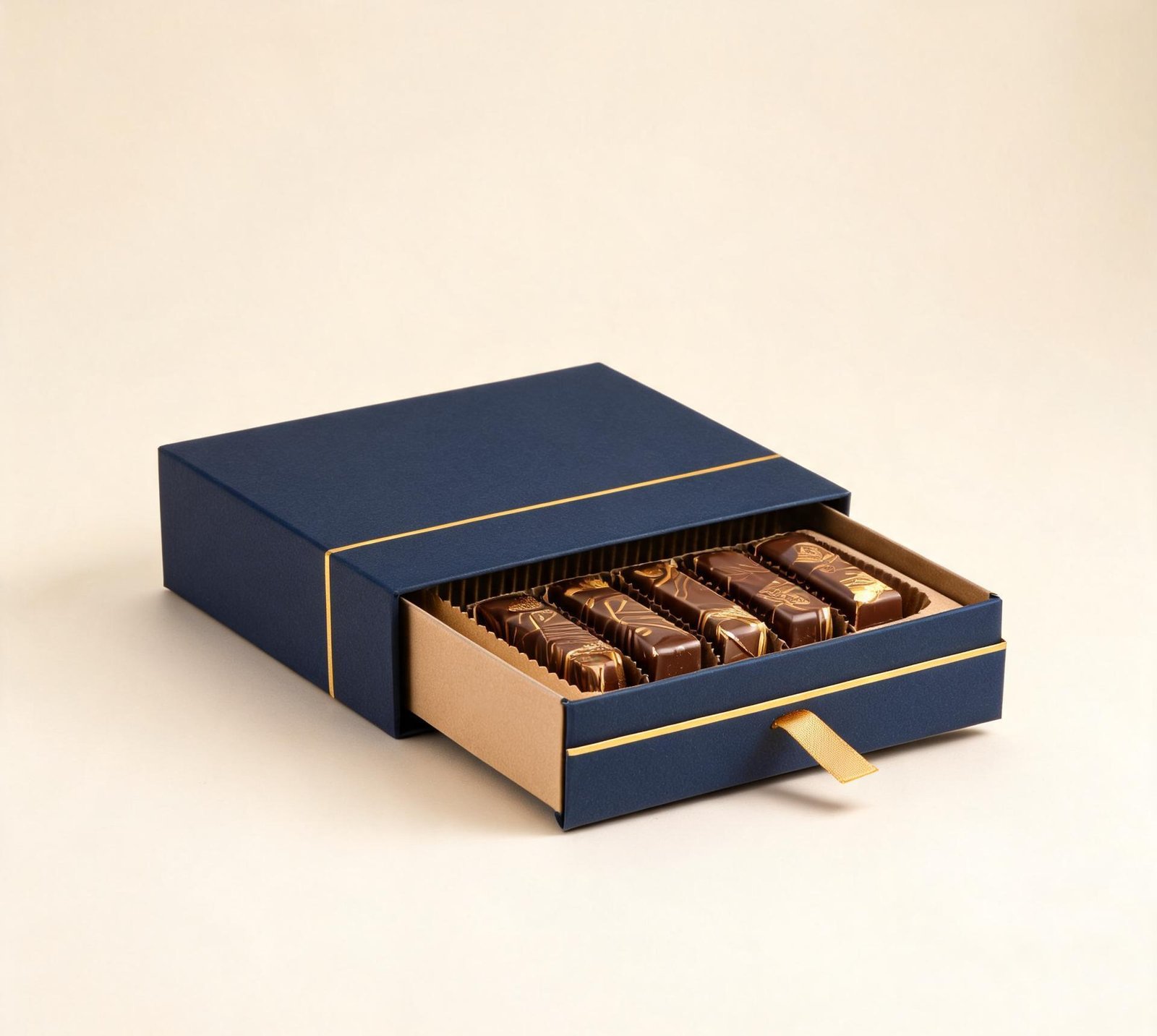
For assortments, a rigid drawer box reads most like a gift. The sleeve carries the print and the food-safe tray slides inside, so the outer box can be recycled greyboard while the tray carries the barrier. Assembly drives the cost: a drawer box takes roughly twice the hand labour of a lid-and-base.
Windows, films and barrier choices
A window lets the product sell itself. The film behind it decides whether it is food-safe. OPP is the standard: clear, food-grade, 30 to 50 micron. PLA film composts but has a narrow temperature window and can haze in a cold chain, and filmless apertures remove the plastic entirely for wrapped bars.
If a window sits over loose product rather than a sealed bar, add a glassine sheet behind the aperture. Without it the exposed chocolates take the full humidity swing of the shelf, and sugar bloom appears at the film edge first.
Sizing, fill weight and freight math
Three numbers set the box. Cavity count and pitch determine the footprint: 24 pieces at 32 mm pitch need 4 by 6 cavities plus 5 mm walls, roughly 160 by 230 mm internally. Fill weight determines height: 12 truffles at 12 g need about 40 mm of internal depth plus 15 mm headspace. Freight divisor decides whether the box pays for itself: carriers charge volume divided by 5,000 or 6,000, so 10 mm of extra height on a 200 mm box is billed on every shipment.
Size the tray first, then the box, then the shipper, and confirm finished height before approving the dieline — a tray 5 mm too tall turns a 45 mm box into a 55 mm box permanently.
Finishes that survive retail and cold chain
Confectionery finishes must survive a shelf under fluorescent light for six months and a cold chain cycling between 4°C and 25°C.
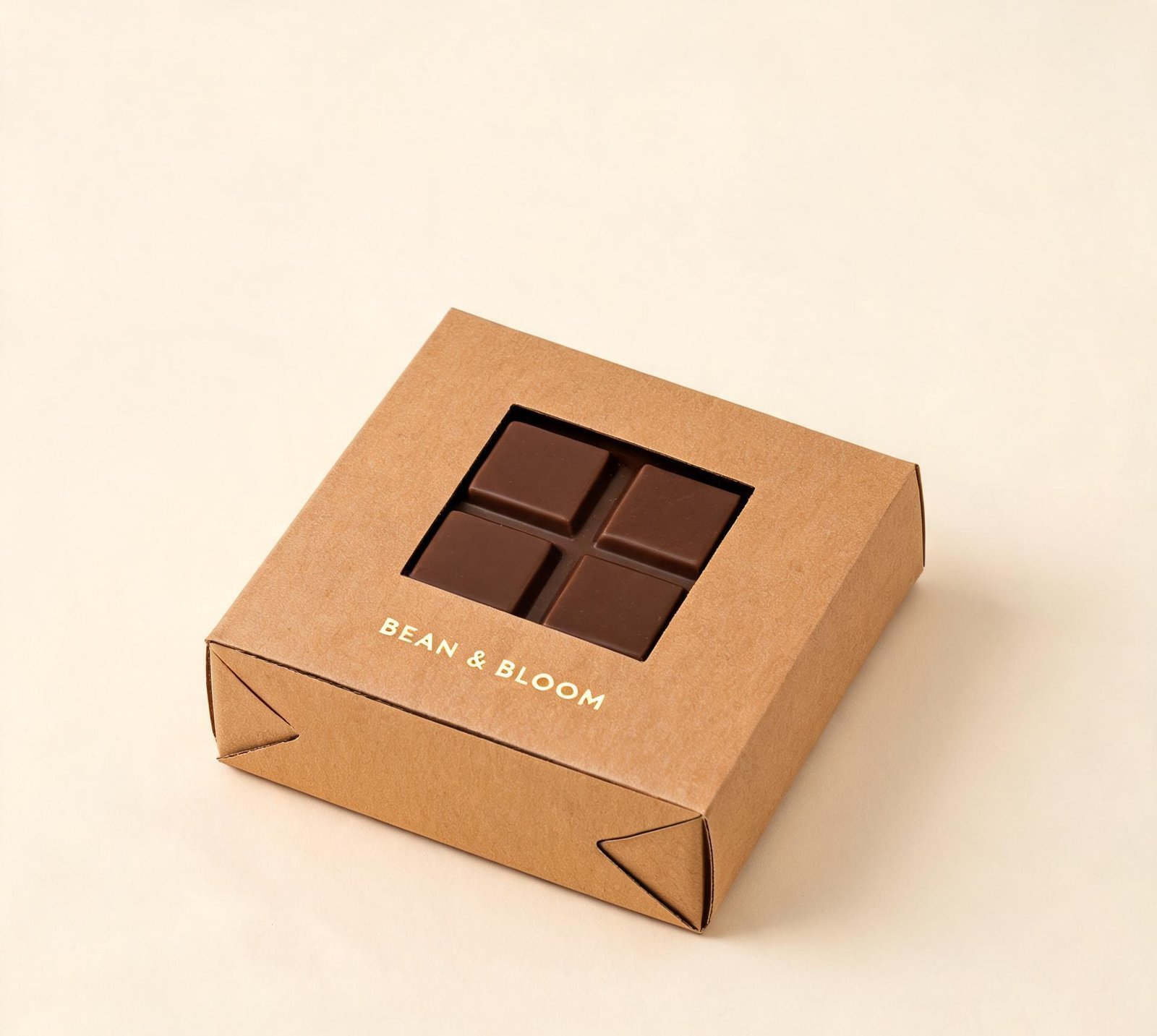
Soft-touch laminate is wrong for a cold chain box: it can cloud and delaminate at the corners after repeated condensation. Matte varnish over a coated sheet gives most of the effect at a fraction of the cost. Hot foil holds on outer rigid boxes and carton faces, but keep it off the contact panel, and avoid heavy ink coverage across the whole sheet — it slows the press and increases migration risk.
The cheapest premium-looking combination is uncoated kraft, two spot colours and one foil line: fast to print, stable in humidity, and it reads artisan rather than mass-market.
Sustainability claims you can defend
Three claims hold up: FSC-certified board with chain-of-custody documentation on request; mono-material construction where tray, liner and box repulp in the same stream; and right-sizing, which removes void fill and air. Three do not: “plastic-free” on a box carrying an OPP window; “compostable” on PLA-coated board with no industrial route in your market; and “recycled” on a food-contact layer, which you cannot claim at all.
The realistic position for most brands is a recycled greyboard outer, a coated paper tray and a glassine liner — repulpable as a unit at most mills, no plastic, and cheaper than a mono-material redesign.
How a chocolate packaging project runs
Our process front-loads the two places where confectionery projects fail: the barrier choice and the tray fit. Minimum order is 500 pieces per design. We run chocolate and sweets boxes, food-safe cartons, trays and printing under one roof, so a drawer box and a lid-and-base box can be compared with the same tray inside them.
- Brief and material call. Send product dimensions, piece weight, cavity count, channel and required shelf life. We specify board grade, liner and ink system in one document and draft the dieline at no cost. Two to three working days.
- Sample. Pre-production sample on the specified board and tray in three to five days, including a 48-hour fat migration check with your actual product where the schedule allows.
- Bulk and inspection. Production runs seven to fifteen days after approval. Inspection covers board caliper, cavity pitch, liner overlap, print registration, ink coverage on the contact panel and a drop test at packed shipping weight.
Start your chocolate packaging project with Criio — free dieline within three days, sample within five, and bulk production under fifteen days from approval, with FSC documentation on request.