
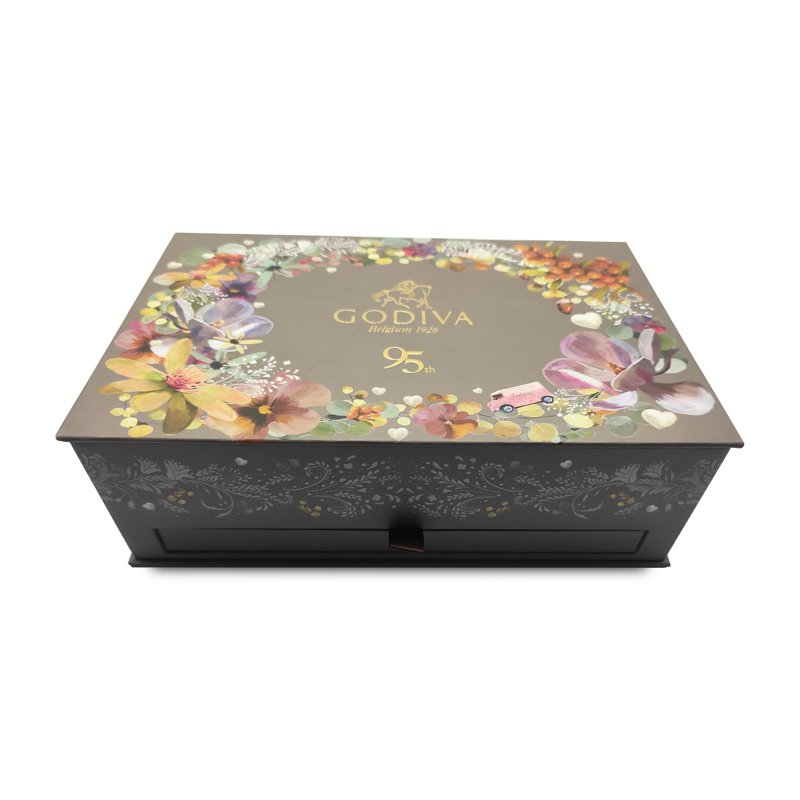
The honest answer to “should we use a rigid box?” is almost never about looks. Rigid and folding carton packaging can both carry a beautiful printed design. What differs is the construction, and therefore the tooling, the minimum order, the freight volume, and the first ten seconds of the unboxing.
The structural difference in one sentence
A folding carton is one piece of chipboard, printed, creased and glued into a flat shape that the customer or your team erects. A rigid box is a set-up box: greyboard is wrapped in printed paper and assembled over former tools by hand or with a forming machine, and it arrives already a box. It cannot collapse, so it never needs erecting — and it cannot be flattened, so it never ships small.
Cost, MOQ and lead time
- Folding carton. Tooling is one die and one set of plates. Typical MOQ starts around 500 pieces per design, unit cost is low, and lead time is short because the carton runs on the same equipment as everything else.
- Rigid box. Wrap printing still runs on the offset press, but the forming step is labour and fixture time, and the inner tray is usually a separate tool. Plan for a higher MOQ, higher unit cost, and a lead time several days longer for the same quantity.
The freight line is where people get caught. Fifty rigid boxes occupy many times the volume of the same fifty cartons folded flat, so a container that holds six months of carton inventory may hold two months of rigid inventory. Cheap to make is not the same as cheap to land.

When a folding carton is the better box
Choose it when the product is under roughly 500 g, when the box lives on a shelf or inside a shipping carton rather than being handed over, when you need to reorder a modified design quickly, or when you are launching and the SKU has not proved itself. It is also the right answer for any product that gets boxed by an operator at speed — a carton that pops open in one motion beats a beautiful rigid box that takes three.
When the rigid box earns its price
Choose it when the box is part of the product: fragrance, watches, jewellery, skincare gift sets, electronics at a premium tier, spirits, and anything sold as a set. Two things you are buying are structural. The walls resist crush, so a boxed item can travel without an outer master carton doing all the work. And the lid lifts off or hinges rather than flaps open, which means the packaging survives being left on a dressing table — the box is still in use a year later, which is the cheapest advertising there is.
Check the product before the budget
- Weight and fragility. Over about 800 g, a chipboard carton wants a rigid base or an insert anyway.
- Expected handling. Retail shelf, in-carton, or hand-to-hand? Repeated opening kills a tuck end long before it kills a rigid box.
- Price point. Packaging usually wants to sit at 5–10 percent of retail price. A 12 unit cannot carry a 9 box.
- Assembly reality. Who erects it, and how long does that take at your packing rate?
- Reorder cadence. If your design changes every season, a heavy rigid tooling investment amortises badly.
The middle path most brands should look at first
You do not have to pick one. A folding carton with a rigid lid reads as a premium box and ships mostly flat. A corrugated mailer with a printed wrap, or an unprinted rigid box with a printed paper insert, carries the brand message without paying for print on every surface. A die-cut EVA or paper tray inside a simple carton protects the product better than a heavier box does.
Tell us the product, the price point and how it ships on our contact page; we will quote both structures side by side so the decision is made on numbers.